International students shocked, disappointed over Trump administration’s Harvard University ban
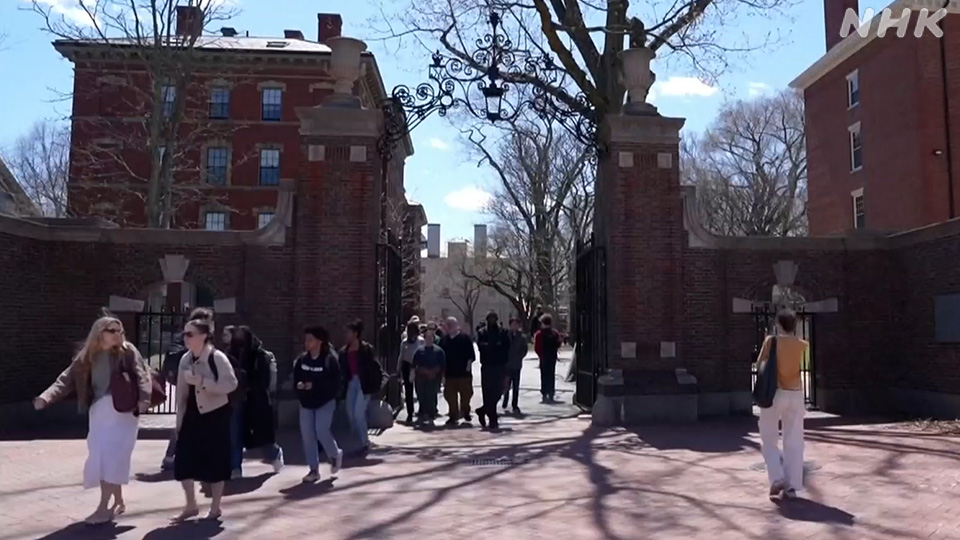
The Trump administration is stepping up its pressure on the country’s highest educational institutions. International students at Harvard and beyond have responded with shock and disappointment to the Trump administration’s order preventing the university from enrolling foreign students.
Harvard says order ‘unlawful’
The institution hosts over 10,000 foreign students and researchers from more than 140 countries and regions. Harvard University told NHK that foreign students are making an immeasurable contribution to the university and the US. Harvard says the government’s measure is unlawful, and it is working to continue to accept international students and researchers.
It also says the Trump administration’s retaliatory measures threaten to seriously damage the Harvard community and the country, and that they undermine Harvard’s academic and research missions.
Trump administration vs. Harvard
The Trump administration and Harvard University had been at odds over how to deal with students.
The US education ministry issued a statement in March this year, saying that it would review subsidies and contracts worth a total of about 9 billion dollars to Harvard University and its related organizations.
The move came after a series of demonstrations against Israel’s attack on Gaza were held at universities across the United States last year, and reports that Jewish students were harassed at that time. The administration claimed that Harvard University did not protect students from anti – Jewish discrimination.
In response, Harvard University argued that it had already strengthened measures against antisemitism. It also rejected a funding ultimatum issued by US President Donald Trump, and his demand for immediate reforms on student discipline policies and an end to all DEI programs.
The Trump administration immediately fired back, freezing part of Harvard’s funding. Harvard called the freeze “unlawful and beyond the government’s authority.” It filed suit with a federal court in April to block it, accusing the administration of using the funding to try to gain control of Harvard’s academic decision-making.
The administration is escalating its battle against the elite university. Earlier in May, Trump said on social media it would revoke Harvard University’s tax-exempt status. He did not mention when the status would be canceled.
Harvard University responded in a statement that there is no legal basis to rescind its tax-exempt status. It said such an unprecedented action would result in diminished financial aid for students. It added there would be grave consequences for the future of higher education in the United States.
Students stressed
Anxiety is spreading among foreign students, some of whom have returned to their home countries for summer vacation.
Among them is Karl Molden, from Austria. He says, “I think the word that describes our emotion the best right now is “confusion.”
Molden says he doesn’t know whether to go back to the US before the situation worsens, continue his vacation, or even apply to some other university.
Rauf Nawaz, a student from Pakistan, says he is disappointed and extremely frustrated.
Nawaz says if he is not allowed back into the United States to attend Harvard University, he would “completely lose all respect” for the country, and for the “entire higher education culture that has been developed in the US.”
The decision has also shocked students outside Harvard, who respect the world-famous university.
NHK spoke about the ban with students at one of Japan’s top schools — The University of Tokyo.
One student says: “I’m kind of upset, because I don’t see a reason for them doing that. It narrows down our options for our future.”
Another says he is saddened by the decision, because Harvard is a university he looks up to. He adds that he still wants to go to the US to study, as there are other American universities that specialize in many fields.
Expert: Idea of restricting autonomy shocked many nations
Meiji University Professor Hirobe Izumi earned his Ph.D at Harvard.
He tells NHK that the Trump administration’s decision could hurt America’s standing in the world.
Professor Hirobe says, “In the United States, where academic autonomy has been highly valued, the possibility of restrictions on autonomy is shocking to countries around the world.”
He says that means the US is reducing its “soft power.” The term, popularized by late Harvard Professor Joseph Nye, refers to a country’s ability to exert influence through attraction, rather than coercion. Hirobe adds that the ability to attract talented students and researchers may be affected, potentially causing America’s international influence to decline.
